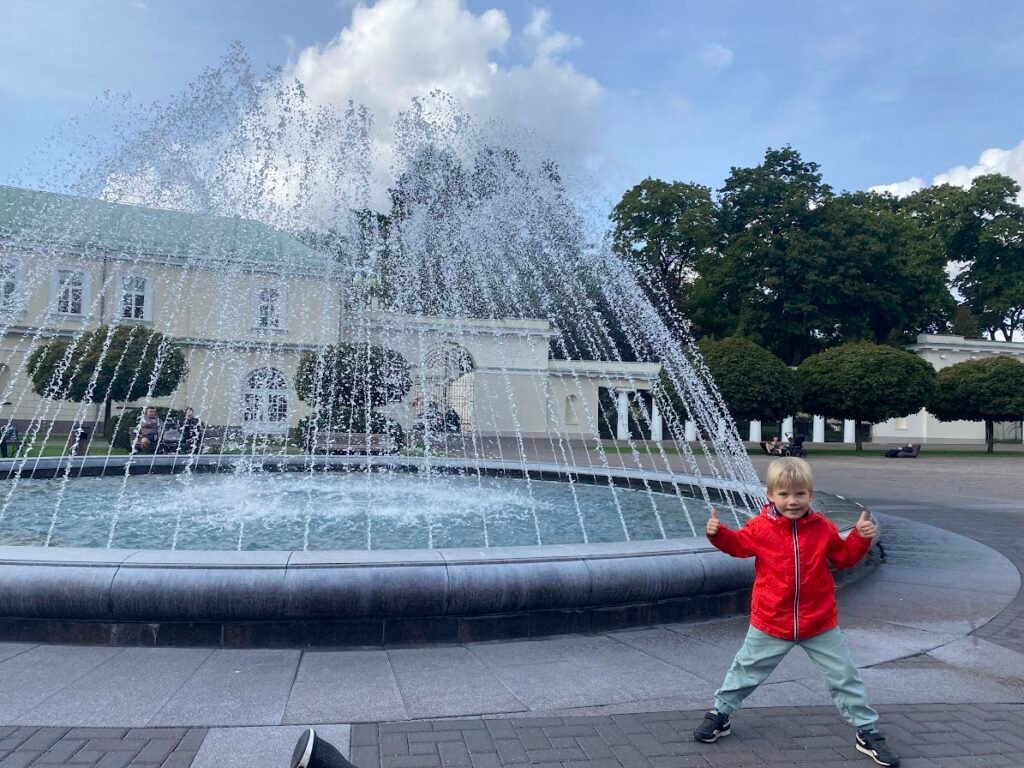

Did you know that there are more than 30 fountains in Vilnius’s public spaces? On hot summer days, these fountains become true magnets for families. Children joyfully splash in the water, play, and run between the fountain streams, while parents can sit nearby, relax, and enjoy the city’s summer vibe with a book. Sometimes, after all, the greatest summer pleasures lie in the simplest things.

Which Vilnius fountains are worth visiting with kids this summer? Some are well-known, while others are more hidden, but each one has its own unique story and charm. In the “Neakivaizdinis Vilnius” fountain list, you might discover your family’s new favorite spot – a place to cool off, play, or enjoy time together. We also invite you to rediscover Vilnius parks – from your favorite green areas to lesser-known corners, where the city slows down and offers green experiences. You’ll find a detailed article on Vilnius’s green spaces, perfect for a family picnic.
Vilnius fountains: which ones are worth visiting with kids this summer? (click on any fountain name for easy navigation)
Washington Square fountain
On the site of the old fountain, the new beauty began to flow again after reconstruction on July 23, 2020. Do you know why this date matters? On that very day, exactly 80 years ago, U.S. Secretary of State Sumner Welles issued a declaration condemning the occupation of the Baltic States and supporting their aspiration for independence. There is even a memorial plaque next to the fountain, with the official statement engraved in Lithuanian and English. Clearly, the fountain’s activation date is no coincidence, since its location is special – Washington Square. The square received its name in 1996 after a visit by U.S. Secretary of State Madeleine Albright. Therefore, the beautifully landscaped square and the classical fountain are like an open U.S. embassy, which anyone can visit.
Location: Vašingtono a. (Washington Sq.) 1, near Lukiškės Square and the White Bridge
↩︎ Back to list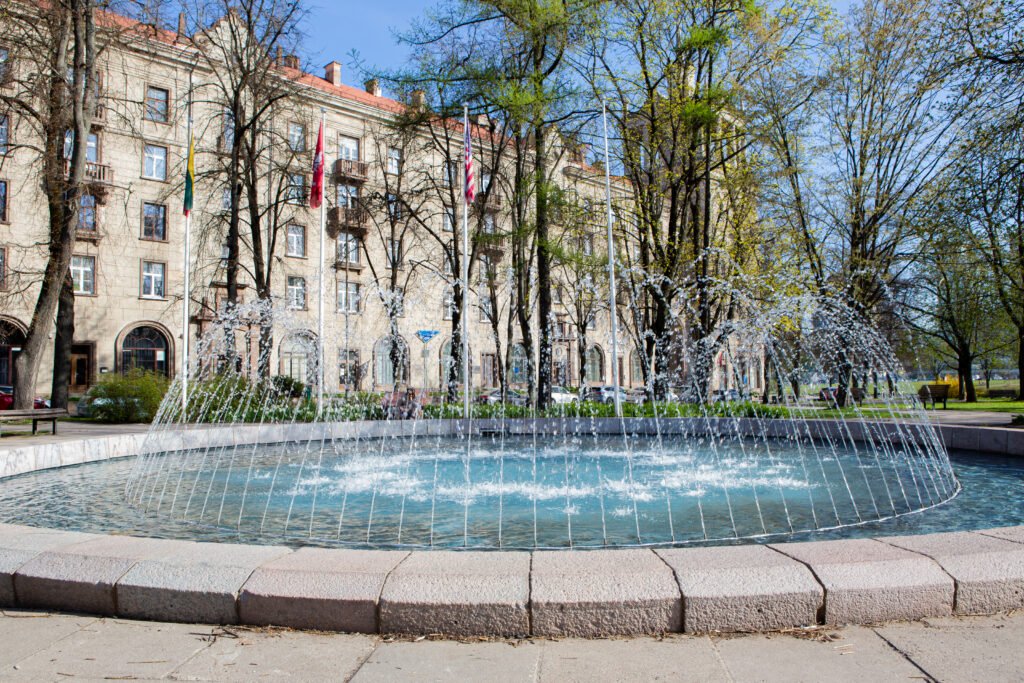
Lukiškės fountain
You’ll probably agree that the reconstruction of Lukiškės Square was the most talked-about project in Lithuania. Many disputes and emotions surrounded the Vytis monument and the partisans’ mound. However, it’s wonderful that one of the city’s most modern fountains quickly won the hearts of Vilnius residents and visitors alike, with little controversy.
The uniqueness of this interactive fountain is the movement of water jets, which respond to people’s movements detected by special cameras. Thus, every passerby – intentionally or not – can influence the water’s flow. Of course, the fountain especially attracts the city’s youngest residents. It’s fun to dive between the jets and try to get wet. Yes, exactly – to get wet, not the opposite, because when a person approaches a jet, it stops spraying. The shapes and heights of the jets change according to a programmed scenario and can vary up to ten times per second. And those are not all of its features! Come after dark, and you’ll see colorful streams as the special lights work both individually and in sync with others.
By the way, after sunset, you can even operate the fountain – it responds to hand movements. Isn’t that the perfect opportunity for students from the nearby Music Academy to practice conducting skills?
Location: Gedimino Ave.
↩︎ Back to list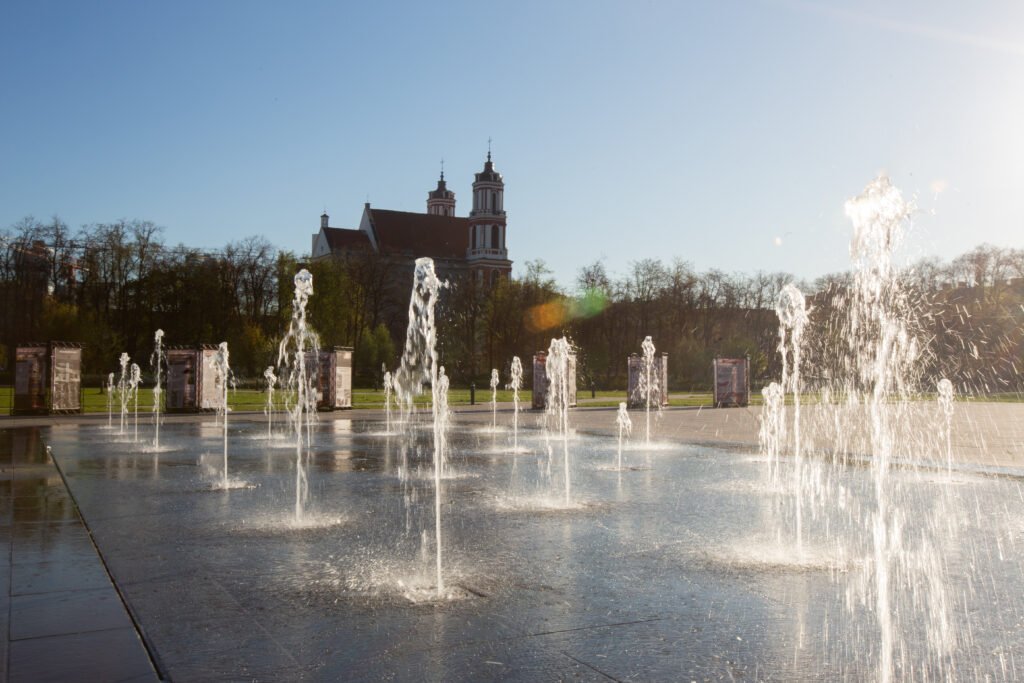
Opera and Ballet Theater fountain
In 1974, young architect Elena Nijolė Bučiūtė designed the Lithuanian National Opera and Ballet Theatre, which was extremely modern for its time. Not only was the theatre building itself remarkable, but also its surroundings: the stairs, pavement, benches, and, of course, the functionalist-style fountain. Architect Aleksandras Stasys Lukšas created unique architectural cascades, giving the impression of a flowing river and peace, instead of competing with the theatre’s grandeur. The fountain became a wonderful oasis in the city center. For a long time, it was neglected, but in 2019, the urban cascades began to flow again. To everyone’s delight, the careful reconstruction preserved its authenticity. To celebrate its revival, Richard Strauss’s opera “Salome” was screened on a large cinema screen at the theatre’s entrance, featuring the best 2018 opera soloist, Asmik Grigorian.
Location: A. Vienuolio St. 1
↩︎ Back to list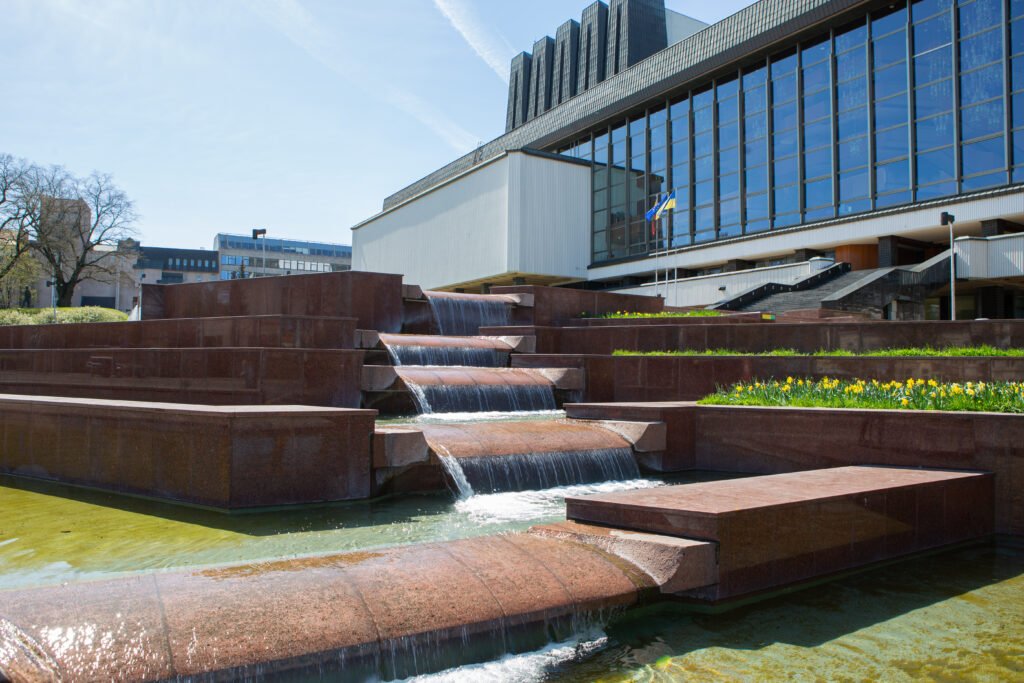
Fountain by the Lithuanian Institute of History
Almost everyone who passes the Lithuanian Institute of History on Tilto Street notices the unusual and distinctive fountain in its courtyard. After the building was reconstructed in 2004, the Central Mortgage Office planned to move into building number 17. Once the renovation of the building and courtyard was complete, the institution’s head came up with the idea of creating a unique decorative fountain. As usual, the team announced a competition to find the best design. The winner, the “Vilniaus puodžių cechas” NGO, submitted six projects, and the work by Elena Aleksejeva was chosen. Although the official name is lacking, locals affectionately call it the “Ring” or “Blossom.” This “Ring” is special because at night it doesn’t close up but instead glows in various colors. If you don’t believe it, come and see for yourself after dark.
Location: Tilto St. 17
↩︎ Back to list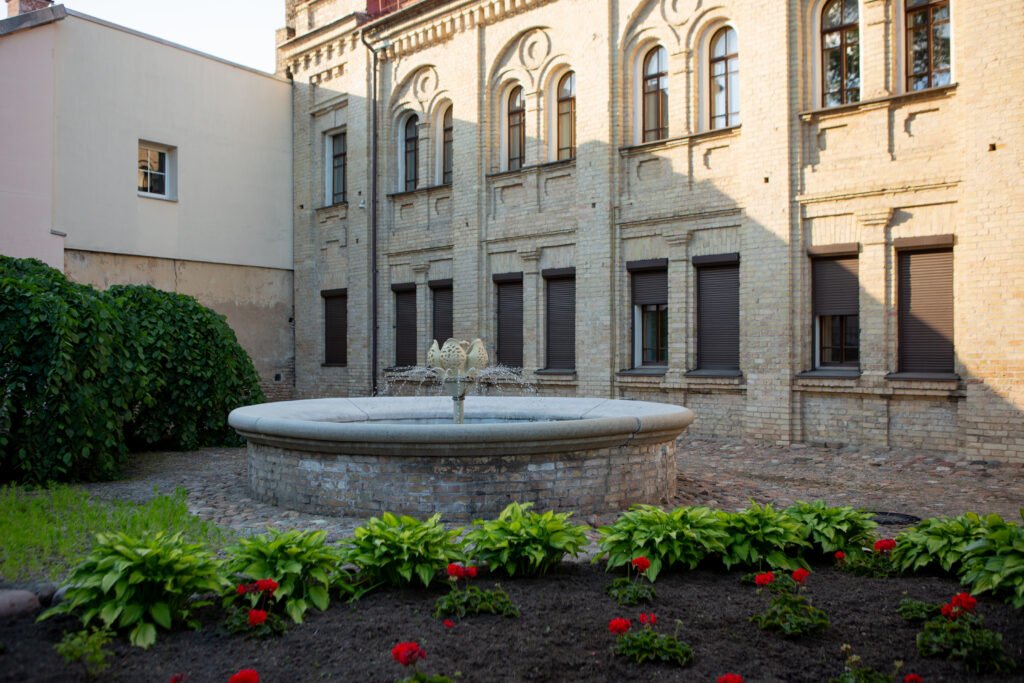
Girl with an umbrella
Even if you have never visited this courtyard at Tilto St. 3, you will immediately recognize the sculptor behind the fountain-sculpture. His distinctive works are well known and loved by Vilnius residents: Boy with a Galosh, Water Carrier, Dr. Cemach Shabad, Leonard Cohen, and other figures. Have you remembered the name? Romualdas Kvintas. The renowned sculptor created this fountain to decorate his own courtyard, which is why many have never seen it. The model for this work was a twelve-year-old neighbor, who is now much older, but the fountain-sculpture has immortalized the moment – the girl will always remain twelve.
Location: Tilto St. 3
↩︎ Back to list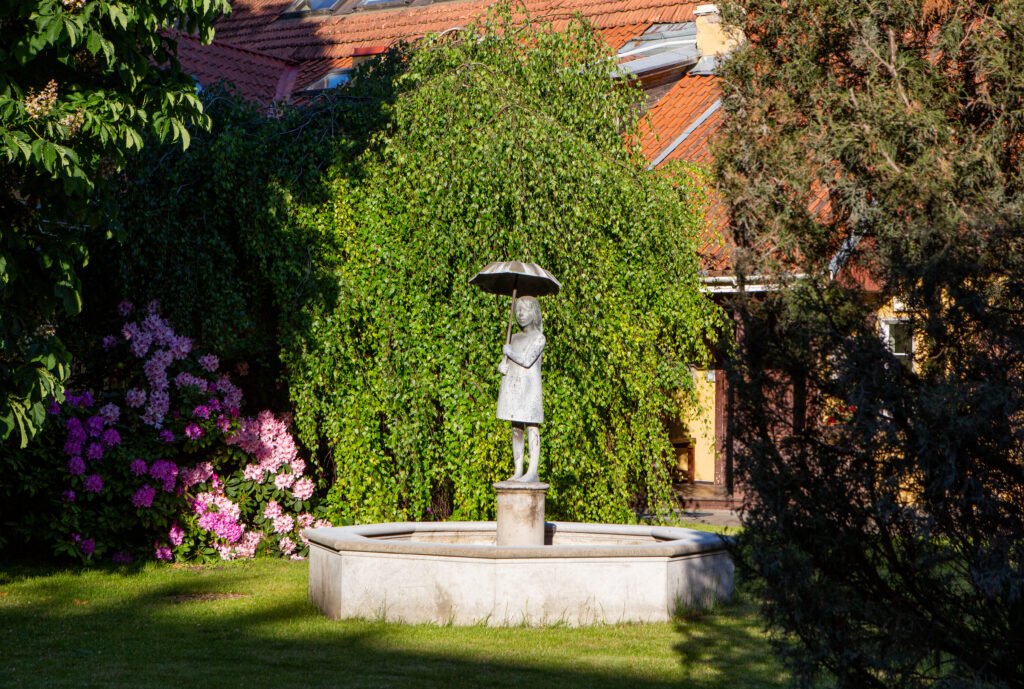
Odminių Square fountain
In 2004, the renovated square became a small green space inviting you to slow down and remember the past. This historic location recalls the times of Šventaragis, when there was a valley with a shrine and royal tombs, as well as the outer bailey of Vilnius Castle. Thus, Odminių Square is also known as Šventaragis Square. The buried courses of the Vingrė and Vilnia streams, which once separated the castle and city, run through here. You can sit on a bench and contemplate the past, looking at the wonderful view of Cathedral Square. Even the pavement fountain is a reminder of the past. Installing the fountain where there was once a swamp was a brilliant idea by the reconstruction plan’s authors. The modern pavement fountain connects the past and the present, and the gentle flow and wet pavement remind us of the days when a swamp lay here.
Location: L. Stuokos-Gucevičiaus St. 1 (near the intersection with Šventaragio St.)
↩︎ Back to list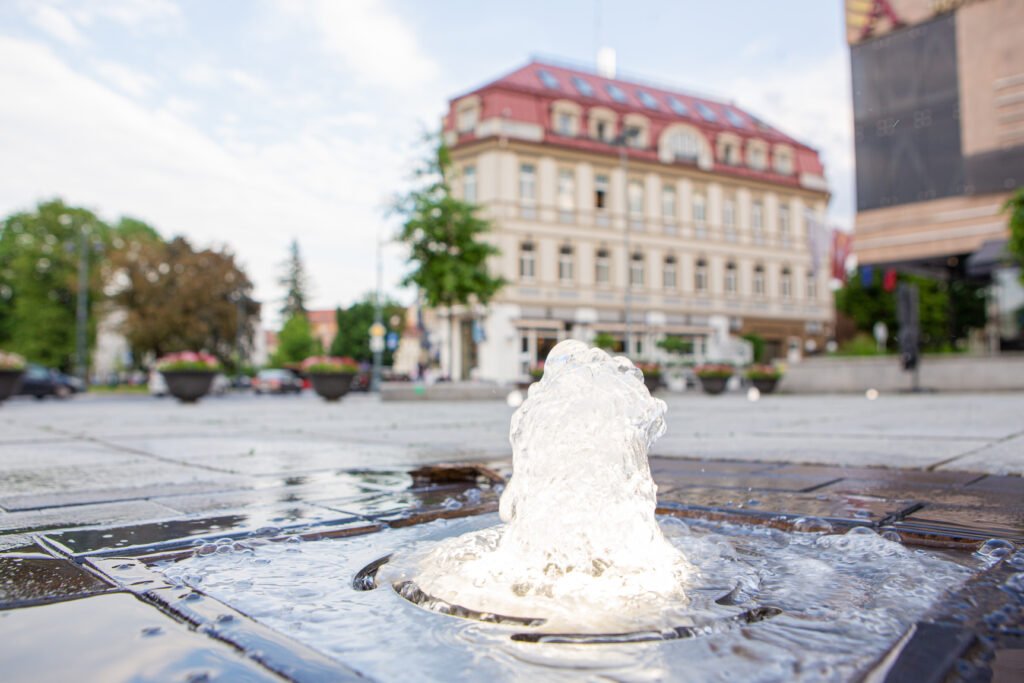
Bona Sforza Renaissance Garden fountain
In 2018, Vilnius opened a Renaissance-style garden in the heart of the city, between the Palace of the Grand Dukes and Gediminas Hill. Although the garden does not date back to Bona Sforza’s time, its creators designed it to honor the gardening-loving duchess. Stairs once connected her apartments to the garden, allowing her to step directly into an oasis that reminded her of her Italian homeland. Bona Sforza also famously missed Italian cuisine while living in Lithuania. Therefore, the garden established at her request grew fruits, vegetables, and herbs popular in Italy. Besides the typical Renaissance plants, you will also find another essential element – a fountain. The composition is classic: an octagonal basin with a vase and overflow plate in the center. Such a structure repeats the traditional manor architecture used until the 18th century.
Location: The Royal Palace, Cathedral Sq. 4
↩︎ Back to list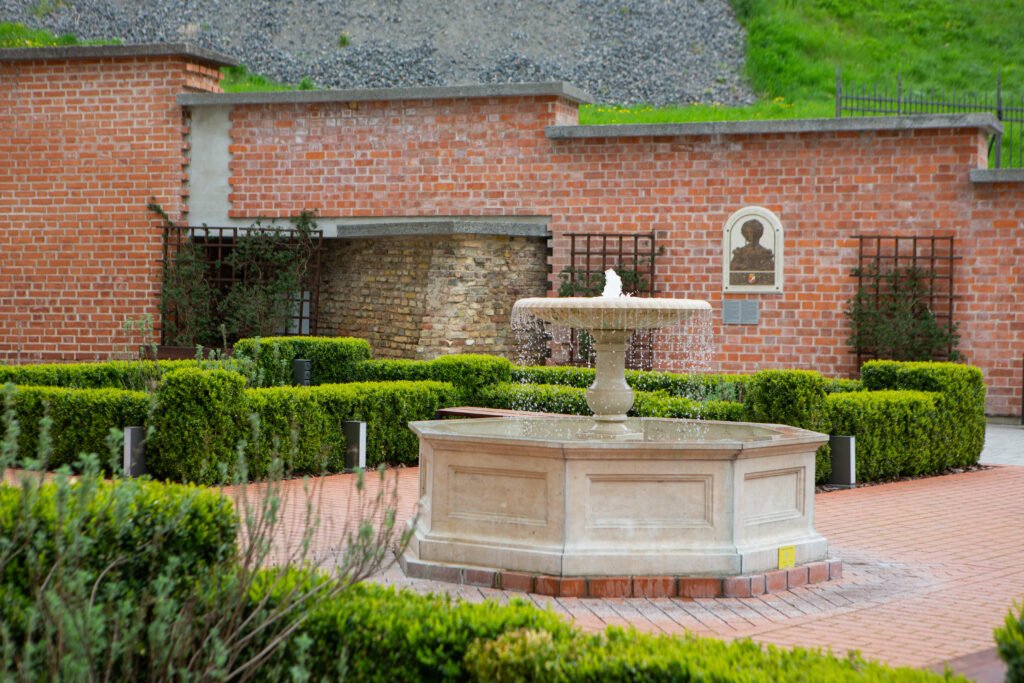
Bernardinai Garden fountain
Bernardinai Garden is one of the oldest public spaces in the capital, where you can feel the touch of nature and immerse yourself in the joyful bustle of the city. The history here dates back to 1469, when King Casimir Jagiellon invited Bernardine monks to Vilnius and gifted them this land. Over time, the gardens turned into parks, especially at the end of the 18th century, when Vilnius University sought to expand the botanical garden. The garden went through ups and downs, transforming from a botanical garden to a city park. The name Bernardinai Garden has changed many times. Cafés, restaurants, cinemas, summer theaters, dance floors, monuments, and fountains have all been here. Many have seen, if not in person, then in photos, the long-gone Elephant Fountain. Everything changes, but the love for Vilnius and the river Vilnia remains.
Among the Vilnius fountains worth visiting with kids this summer, the musical fountain in Bernardinai Garden is one of the most popular. During the latest renovation in 2013, there was an attempt to partially recreate the environment designed by 19th-century artist Aleksander Strauss. Today, the main path leads to the central fountain. In Strauss’s time, there was an outdoor theater here. The current musical and dancing fountain, also known as the Rose Square Fountain, entertains visitors with 14 melodies, synchronized with the water cascades. This fountain is a major attraction, drawing crowds both day and night, when the water lights up in color.
Location: B. Radvilaitės St. 8A
↩︎ Back to list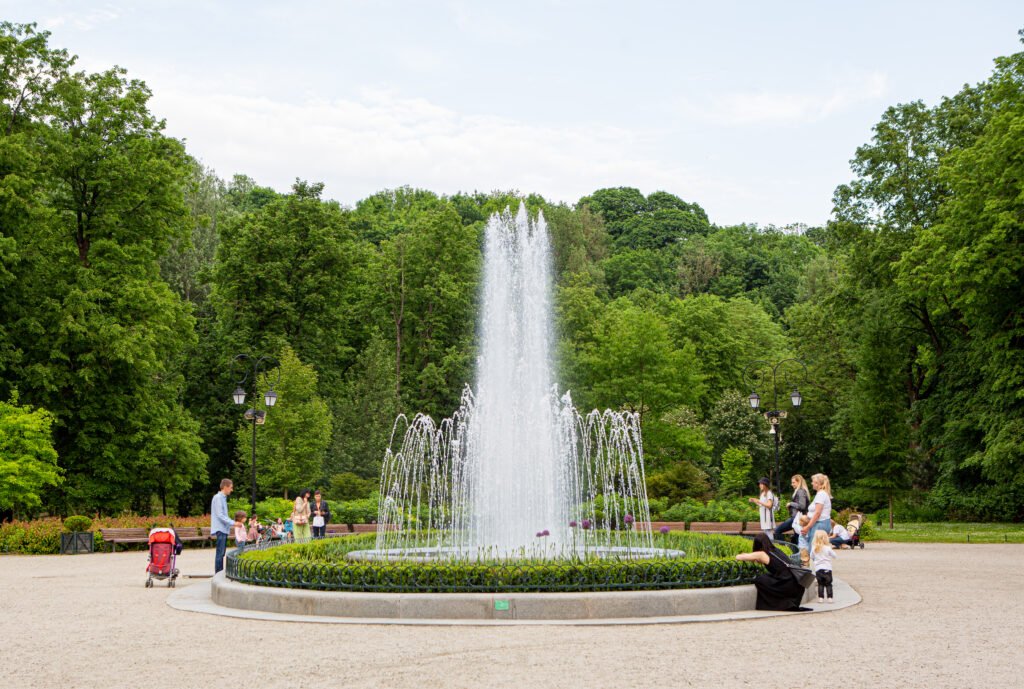
„Šeimyninis dušas“ (“Family Shower”) fountains
If you’re looking for Vilnius fountains worth visiting with kids this summer, the “Family Shower” fountains in “Ogmios City” should be on your list.
This unique five-showerhead installation has become a favorite spot for family outings, fun photos, and cooling off on warm days. Both children and adults love its playful design, which perfectly complements Vilnius’s green and artistic spaces.
Location: Ogmia City, Verkių St. 29
↩︎ Back to list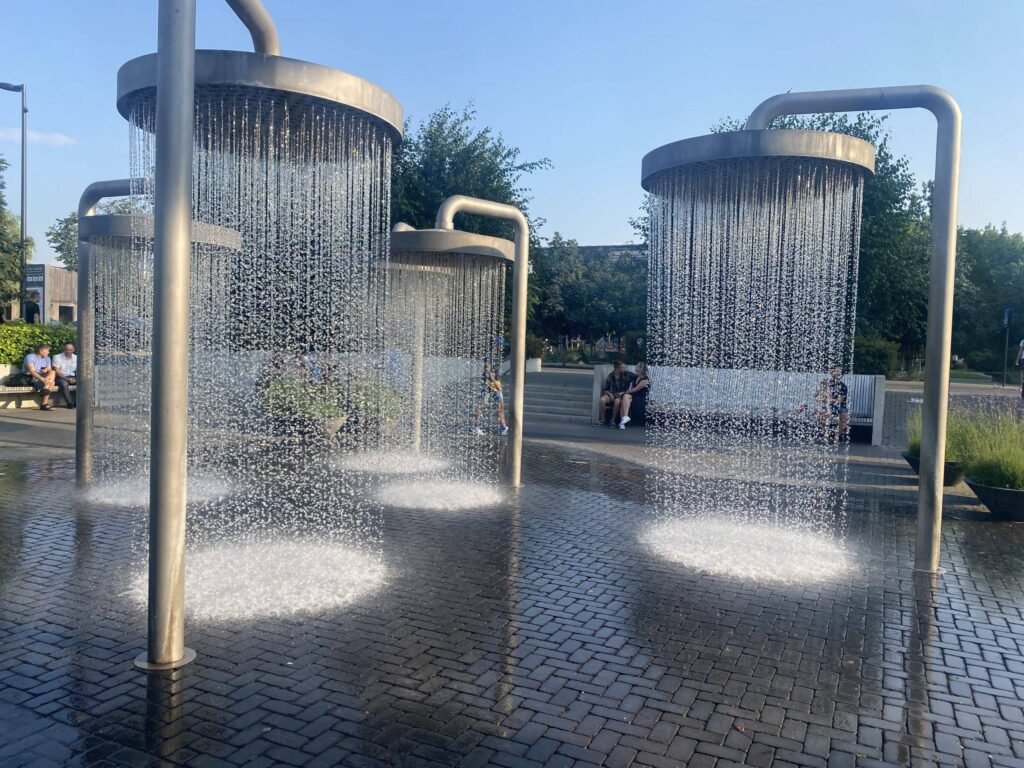
Urban Tap
This is truly one of the newest and most original industrial-style fountains in the capital! After the conversion of the former “Skaiteks” factory, the Paupys business center hosts this unique feature. Some will admire and appreciate the distinct design, while classic fountain fans may be less enthusiastic. Architect Audrius Ambrasas, who designed the fountain, explains: “The stream from the open tap fills the bowl and overflows, as if a Paplauja spring or a leftover industrial pipe were connected.”
So, let’s listen to the fountain’s babble, relax, and travel back to the times when springs flowed here, or later, when industry buzzed.
Location: Aukštaičių St. 7, near Paupys Market
↩︎ Back to list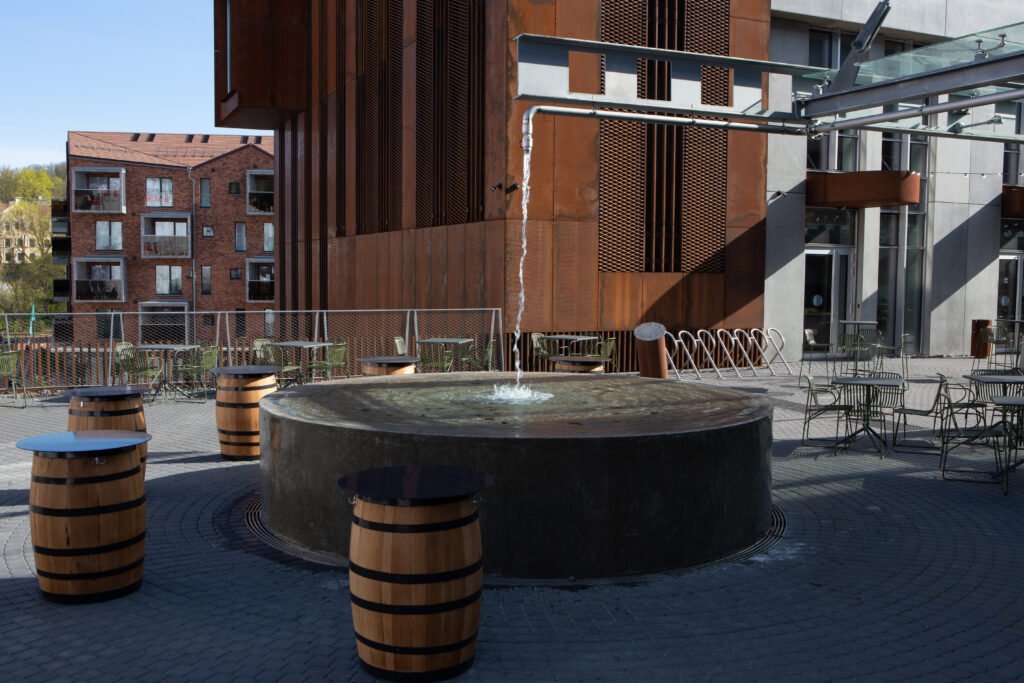
Dynamic pavement fountain in Paupys Square
The main highlight shaping Paupys Square is the dynamic pavement fountain. While not groundbreaking in design, it is reminiscent of the fountains in Lukiškės Square or Odminių Square. However, it brings warmth and playfulness to the strict lines of the urban environment, uniting business and residential spaces. The line of fountains follows the route of a canal that once cut through the bend of the Vilnia, forming an “island.” The water line concept is well-expressed, and historical continuity is maintained.
Location: Aukštaičių St. 12, Paupys
↩︎ Back to list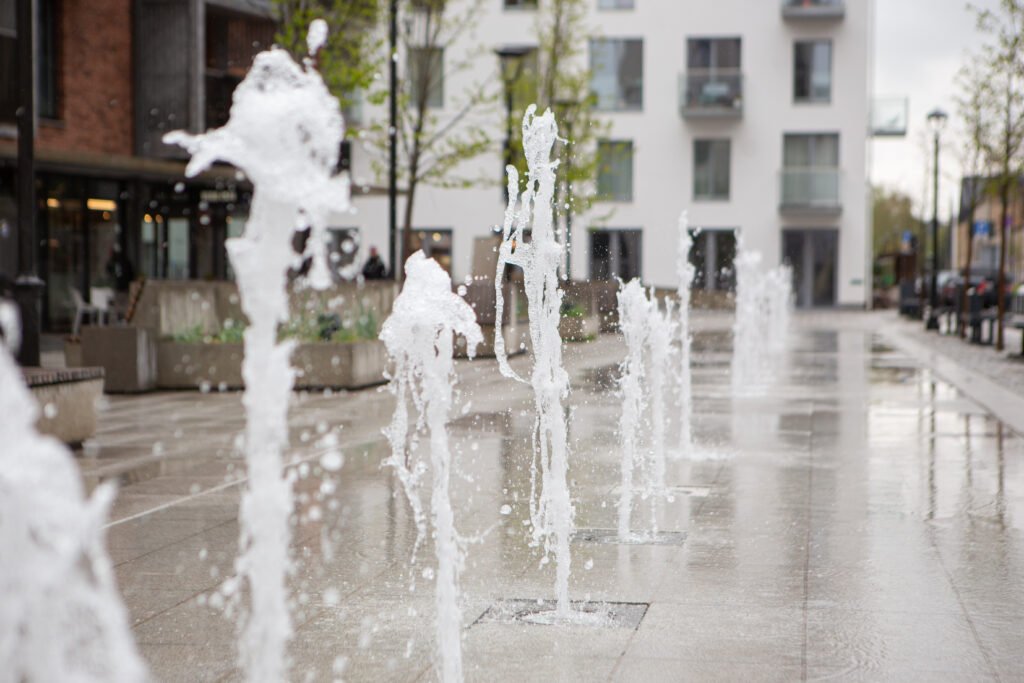
Konstantinas Sirvydas Square fountain
Locals often call Konstantinas Sirvydas Square “French Park,” and the fountain is certainly its highlight. People meet here for dates, and locals and visitors relax here. The fountain has been a central attraction since Soviet times. On hot days, young people rest on the fountain’s edges, skaters ride, and families play.
Do you know where this fountain is located? It has always been a lively spot, where busy streets intersected, and trade flourished. From 1853 until Soviet times, publisher Józef Zawadzki’s bookstore operated in one of the houses here. It offered not only books but a reading room, a musical instrument shop, and, later, a publishing house. The buildings suffered heavily during World War II, leaving ruins for years. The houses were demolished in the late 1950s, and the square with its fountain was later established.
Location: Pilies St.
↩︎ Back to list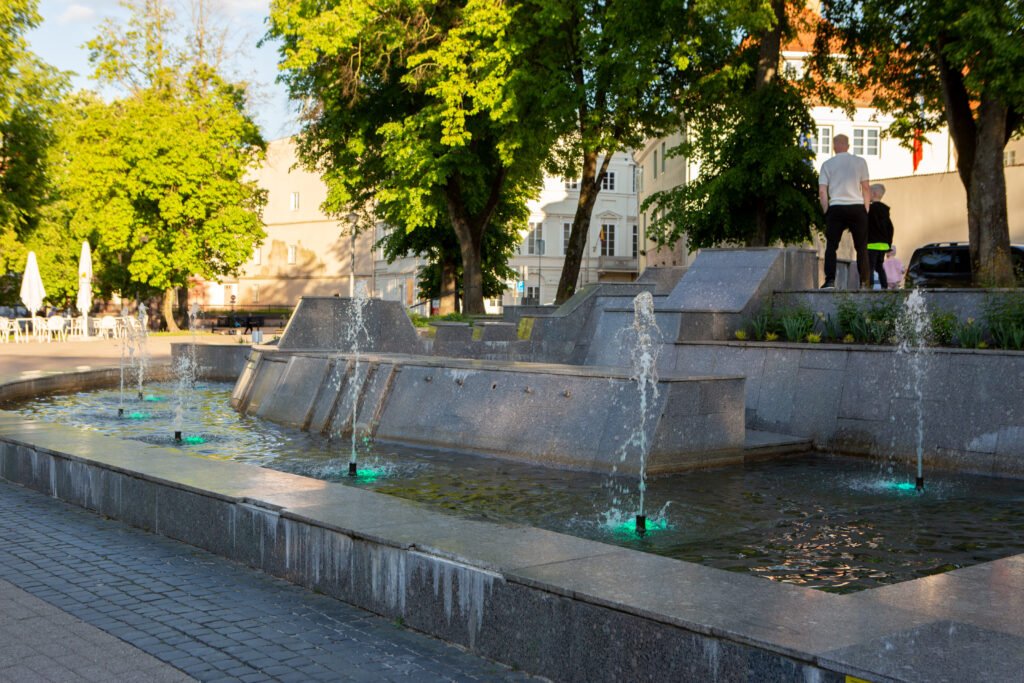
Town Hall fountain
One of the first public fountains in Vilnius appeared in Town Hall Square at the end of the 19th century. The appearance of the square changed most in the 19th–20th centuries, as its purpose shifted from a market to a leisure zone with lawns, benches, and eventually a fountain. Wars also brought significant changes, damaging both the square and the city. Unfortunately, the author and exact date of the first fountain are unknown. Its fate is also unclear. The square was redesigned in 1908 and 1914, planted with grass and fenced, and Christmas tree markets took place here. After World War II, a flowerbed was established.
After the 2007 reconstruction, Vilnius gained another fountain. There were many suggestions about its design. Initially, a large modern fountain with a St. Christopher sculpture was planned, but it was considered too big and noisy. Eventually, a classic octagonal fountain was chosen, set on a white granite platform. This shape was once very popular across Europe because it was difficult to carve a perfect round shape from stone. Interestingly, there was an idea to install a press kiosk underground, but it was abandoned – now, everyone ‘reads’ on their phones anyway.
Location: Didžioji St. 15
↩︎ Back to list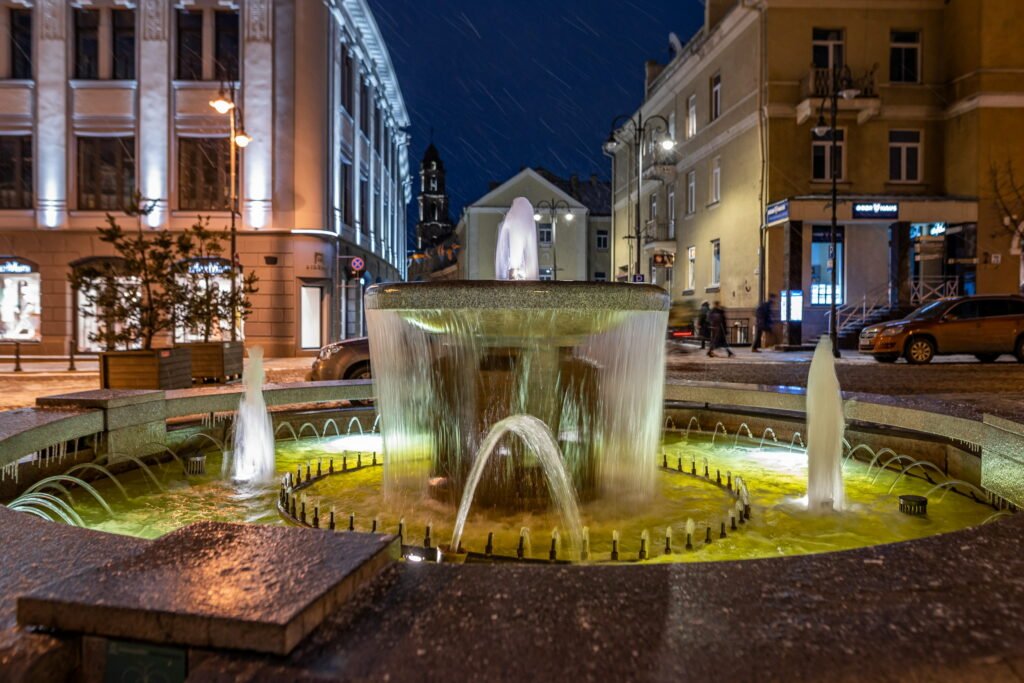
Vokiečių St. fountain
After the 2013 renovation, Vilnius residents can again enjoy the dandelion-like fountain on Vokiečių Street. Its delicate shape symbolizes fragility and transience – precisely the kind of existential thoughts you might ponder while walking down Vokiečių Street, whose history reminds us of the tragic losses of World War II: Holocaust victims and destroyed buildings. The gentle flow of the fountain reminds some people of rain, while to others it might whisper, “Memento mori.” Pause and listen to what the fountain tells you.
Location: near Vokiečių St. 18
↩︎ Back to list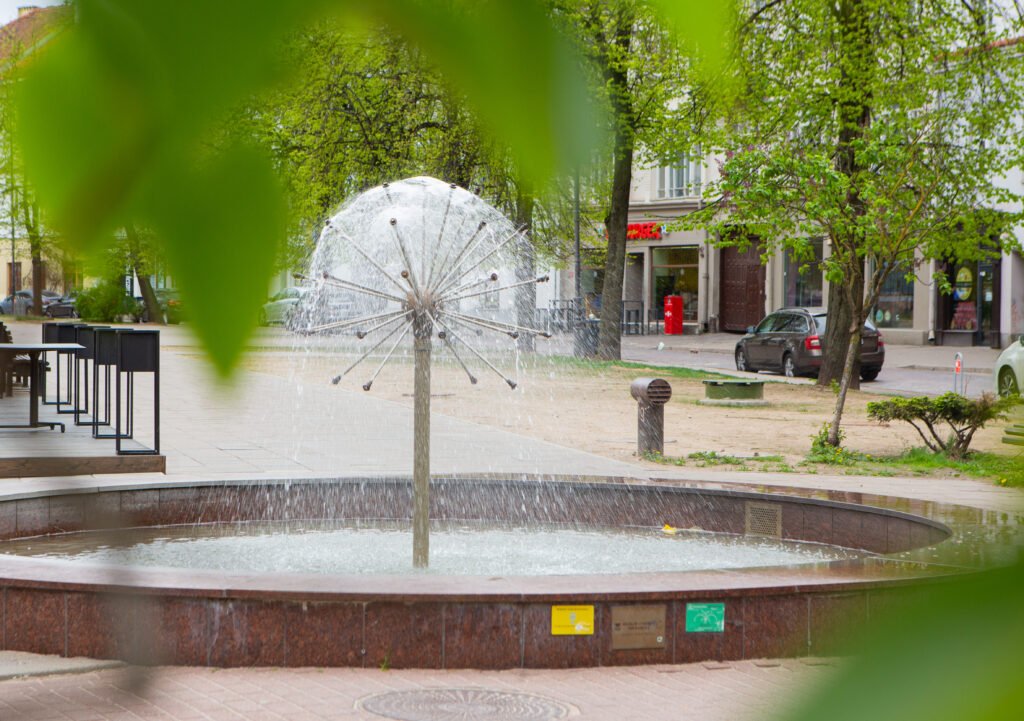
Reformation Square fountain
The newest fountain in Vilnius also honors Reformation figures whose contributions to the Lithuanian language and culture deserve far greater recognition. Everyone knows Martynas Mažvydas, author of the first Lithuanian book, but there were many other pioneers, such as Abraomas Kulvietis, Stanislovas Rapolionis, Jonas Bretkūnas, Abraomas Volanas, Mikalojus Radvila the Black, Mikalojus Radvila the Red, and others. Sculptor Dalia Matulaitė’s monument stands out for its use of water, symbolizing life, eternity, and the breakthrough of free thought.
The territory was historically significant but previously little researched and rich in artifacts. The square’s redevelopment faced many challenges. The aim was to highlight, honor, and commemorate the sites of former buildings and destroyed cemeteries, so the fountain-monument site was moved several times as new sites were discovered.
There is another less visible, less monumental fountain called “Path.” Set on a slope, water flows from the highest point into a decorative stream more than 70 meters long, ending in another pool. The living path invites you to follow the stream and explore the new square, check out the greenery, and find your own favorite spot.
Location: Pylimo St. 18
↩︎ Back to listPresidential Palace Courtyard fountain
Let’s take the opportunity to admire the fountain in the recently opened Presidential Palace courtyard. It’s important to remember that the history of the first palace on this site dates back to 1387, when Grand Duke Jogaila granted privileges here. Of course, the palace underwent many rebuilds and renovations over the centuries. It took on its current appearance in the first half of the 19th century, when Russian architect Vasiliy Stasov redesigned it as the governor’s residence.
Interestingly, the fountain we now see is a new accent for the courtyard. The idea arose in the late 20th century during renovations for presidential use. The city renovated the entire complex in stages, leaving the fountain until the final phase despite having planned its location from the beginning. Many visitors may remember the flowerbed that temporarily occupied the site before the fountain finally took its place. However, there was a fountain near the new governor’s palace in the 19th century, but not in the inner courtyard – it stood in the square in front (now Daukanto Sq).
You can visit the Presidential Palace’s historic park and courtyard with the fountain during the warm season on weekdays from 6 to 9 p.m., and on weekends and holidays from 11 a.m. to 10 p.m.
Location: S. Daukanto Sq. 3
↩︎ Back to list